
How to Hide Seams in Granite Countertops
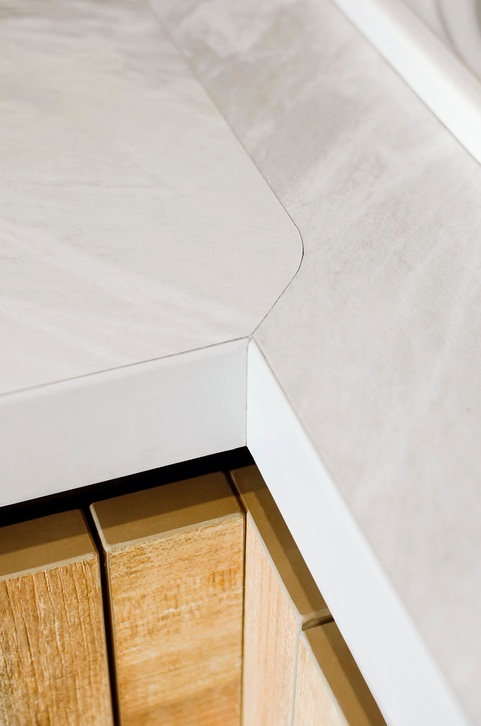
During a kitchen or bathroom remodel, you may be eager to replace your outdated countertops with gorgeous stone slabs. Granite is a surprisingly affordable luxury material perfect for this application. Yet homeowners often notice one detail they wish could disappear: countertop seams.
These thin lines where two pieces of stone meet are a normal part of most countertop replacement projects, but the goal is usually to hide them as much as possible. With thoughtful planning and professional installation techniques, granite seams can blend into the surface so naturally that they’re barely visible.
What Are Granite Countertop Seams?
Countertop seams are joints created when two slabs of natural or engineered stone are bonded together with epoxy. They typically measure 1/16 to 1/8 of an inch wide—the smaller, the better. Seams allow for larger countertop runs, making them a practical necessity when a single slab cannot cover the required space. While some homeowners accept seams as part of working with natural stone, others prefer a smooth, uninterrupted look whenever possible.
How to Hide Seams in Granite Countertops
Experienced installers rely on proven techniques to make granite seams all but disappear. Each method requires skill and attention to detail:
- Strategic placement: The location of a seam makes all the difference. Professionals place seams in areas where the eye naturally overlooks them, such as near sinks, cooktops, or along the edge of a corner. By avoiding central or well-lit areas, installers minimize how noticeable the joint looks.
- Color-matched epoxy: Epoxy serves as the bonding agent that holds slabs together. A generic adhesive would make seams stand out, but professionals carefully mix pigments to match the surrounding stone. The result is a seam that blends into the granite’s most prominent color.
- Precision leveling: Even a slight difference in slab height or angle can create shadows and make the seam feel uneven to the touch. Installers use clamps, suction devices, and leveling tools to align the pieces perfectly. When the slabs sit flush, light reflects evenly across the surface and the seam feels smooth, making it far less noticeable.
- Pattern matching: Many stones feature dramatic veins, swirls, or speckles. To keep seams from interrupting these designs, installers carefully align slabs so that patterns continue smoothly across the joint.
- Book matching: Another technique is to flip one slab to mirror the other so the veining creates a symmetrical design. This approach makes the seam an integral part of the pattern rather than a break in it.
- Polished edges and tight joints: Polishing the stone around a seam softens the transition and makes the joint blend better. Installers also keep seams as narrow as possible. A tight seam with polished edges looks clean, while a wide or uneven seam stands out even with color-matched epoxy.
- Detailed surface finishes: Polished granite reflects the most light, which makes seams more evident in many cases. You might try a honed or leathered finish to scatter light differently, which sometimes makes a seam less noticeable.
- Creative design alternatives: Sometimes the best way to embrace seams is to use them intentionally. A waterfall edge, where the countertop extends down the side of an island, creates a dramatic visual feature. In cases like this, seams are placed deliberately to enhance the design. Similarly, using a full-height stone backsplash draws attention upward, creating a continuous look even if a countertop seam is present.
Strategies to Eliminate Granite Seams Altogether
While professionals have various techniques for concealing granite seams, most homeowners prefer a seamless installation to maintain the continuity of color and pattern. Luckily, this goal is often achievable with careful planning during the design and installation process:
- Use larger slabs: Most granite slabs come in lengths up to 9 or 10 feet, with some specialty slabs reaching 11 or 12 feet long. Choosing a large enough slab for the dimensions of your space may eliminate the need for seams. This consideration matters most for kitchen islands, which are often wider and more prominent than perimeter counters. If your vision includes a grand island, confirm that it can be fabricated from a single slab to achieve the seamless look you want.
- Rethink cabinet and appliance placement: The layout of cabinets and appliances determines where you will install countertops between them. For example, a long row of lower cabinets with no breaks might require two slabs. Adjusting the layout with a refrigerator, range, or pantry cabinet in the middle creates a natural break that helps your countertops fit within slab limits.
- Choose seam-friendly materials: Granite remains a top choice for many homeowners, but quartz, quartzite, marble, and porcelain often come in larger slab sizes or manufactured panels. If your kitchen has an oversized island or wall-to-wall runs, and you’re determined to have a seamless installation, these materials can help you reach your goal. Explore these options in greater detail to help you find a surface that delivers the style you love while minimizing the need for seams.
- Simplify the countertop shape: Complex countertop designs with curves, multiple angles, or unique cutouts are more likely to require seams. Only relatively simple shapes can be fabricated from a single slab due to the risk of breakage during transport and installation. If seamless results are a priority, work with your kitchen or bathroom designer to simplify the layout.
Seamless Results Start with Signature Marble and Granite
Your granite countertops deserve to look their best. At Signature Marble and Granite, we’re pros at hiding seams and creating flawless finishes. We can also involve you in the design process to determine whether eliminating seams is possible with your project. We’ll explain every option clearly and install your countertops with speed and precision for the best results. Contact us today to request an installation estimate in Springville, UT, and start planning countertops that look seamless in every way.