
What Is the Standard Thickness of a Granite Countertop?
What Is the Standard Thickness of a Granite Countertop?
When selecting a granite countertop, color and pattern are often among the first design considerations. However, granite countertop thickness is another important part of the decision. The thickness of the stone can affect the countertop’s appearance, edge profile options, support requirements, and overall installation.
Understanding the standard granite countertop thickness can help you compare your options and make a more informed decision before your countertop is fabricated and installed.
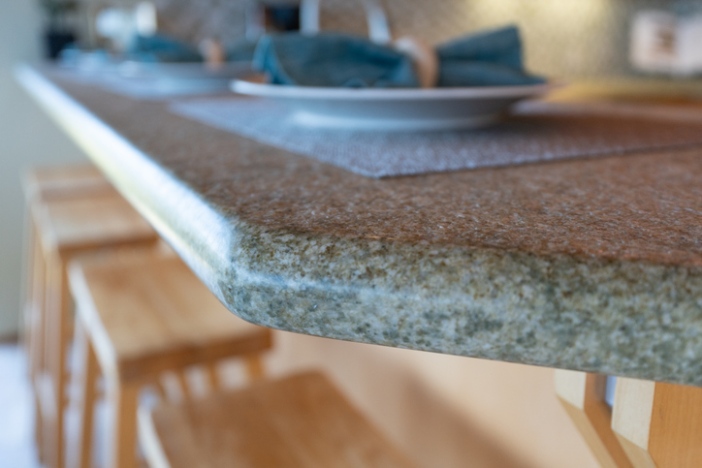
Understanding Granite Countertop Thickness
Granite countertops are commonly available in more than one thickness, with the appropriate option depending on the application and design. The thickness refers to the actual thickness of the stone slab or finished countertop material.
For residential kitchen countertops, approximately 3 centimeters, or about 1¼ inches, is a common granite thickness. Some projects may use thinner material, while other designs can incorporate additional material at the edges to create a thicker visual appearance.
Thickness is not simply an aesthetic decision. The countertop needs to be appropriate for its intended use and properly supported as part of the installation.
What Is the Standard Granite Countertop Thickness?
The most common residential granite countertop thickness is approximately 3 centimeters, or 1¼ inches. This is widely used for kitchen countertops because it provides a substantial appearance while working well with many standard countertop applications.
A thinner slab can also be appropriate for certain projects, but the specific application should be evaluated before selecting a material. The size of the countertop, overhangs, support structure, and desired edge profile can all influence the appropriate choice.
When comparing granite, it is useful to look at the actual slabs available rather than assuming every stone will have exactly the same specifications. Natural stone can vary, and fabrication requirements should be considered as part of the design process.
Granite Slab Thickness Explained
A granite slab thickness of approximately 3 centimeters is a common choice for residential kitchens. The thicker material provides a substantial appearance and can accommodate a variety of edge treatments.
Some homeowners may prefer the visual effect of a thicker-looking countertop. This can sometimes be achieved through fabrication techniques that create the appearance of greater thickness at the edge without requiring the entire countertop to consist of a much thicker slab.
The choice should be based on the overall design rather than thickness alone. The color, pattern, edge profile, countertop dimensions, and surrounding materials all contribute to the finished appearance.
Which Granite Thickness Is Best for Kitchens?
For many kitchens, the standard 3-centimeter option provides a practical combination of appearance and functionality. However, there is no universal thickness that is best for every kitchen.
Consider how the countertop will be used and how the design is laid out. An island with a significant overhang may have different structural considerations than a countertop supported along its entire length by cabinets.
The same applies to areas containing seating. Larger overhangs may require additional support regardless of the countertop’s thickness.
A professional fabricator can evaluate the specific layout and help determine which material thickness is appropriate for the project.
Factors to Consider Before Choosing a Thickness
Several factors should be considered when reviewing your granite countertop specifications, including the following:
- Countertop Layout: The overall shape and dimensions of the countertop can influence support requirements and fabrication.
- Overhangs: Larger overhangs can require additional structural support. Thickness alone does not eliminate the need for appropriate support.
- Edge Profile: The selected thickness can affect which edge profiles are practical and how substantial the finished edge appears.
- Cabinet Support: Existing cabinets need to provide an appropriate foundation for the countertop. Older or modified cabinetry may require evaluation before installation.
- Overall Design: The countertop should coordinate with the kitchen’s other materials and design choices. A substantial edge can create a different visual effect from a more streamlined profile.
Considering these details early can make the fabrication and installation process more straightforward.
Common Misconceptions About Granite Thickness
One common misconception is that thicker granite is automatically stronger or better for every application. While thickness is an important specification, countertop performance also depends on the material itself, how it is fabricated, and how the finished countertop is supported.
Another misconception is that a thicker countertop will always eliminate the need for additional support. Large overhangs and specific layouts can still require appropriate brackets, support, or other structural considerations.
It is also important not to assume that thickness determines the quality of the granite. Granite quality involves characteristics such as the stone’s appearance, durability, and suitability for the intended application. Thickness is one specification among many.
Plan Your Granite Countertop with Signature Marble and Granite
Choosing the right countertop involves more than selecting a stone color. Understanding your kitchen countertop thickness standards, layout, support requirements, and preferred edge profile can help you create a finished countertop that fits both your space and your design goals.
Signature Marble and Granite can help homeowners evaluate granite options and plan their countertops from material selection through professional fabrication and installation. If you are planning a project in Utah County, UT, Salt Lake County, UT, Davis County, UT, Summit County, UT, or Weber County, UT, contact Signature Marble and Granite to explore available granite and discuss your project.
Frequently Asked Questions About Granite Countertop Thickness
Granite thickness can raise questions about durability, support, appearance, and installation. We hope you’ve learned something from this countertop thickness guide and granite installation guide. Here are answers to several common questions homeowners ask when choosing a countertop thickness.
We provide high-quality sinks and faucets, but do not connect the plumbing fixtures for liability reasons. Our crew ensures the sink sits perfectly in place so your licensed plumber can quickly finish the final connections.
Using some thinner materials can work well for bathroom vanities and decorative fireplace surrounds. The exact location, size, and use of the countertop ultimately determine whether or not it is safe to use a thinner slab. Our team can help you make these decisions about slab thickness during the design process.
Yes, adding extra depth significantly increases the natural tensile strength of the stone. This added durability helps prevent accidental cracking around vulnerable areas like sink cutouts or extended island seating overhangs.
Simple, eased edges provide a clean, modern aesthetic that fits almost any architectural style. We bring you directly into the design process to select the perfect finishing details for your unique layout.
Thickness alone is unlikely to determine a home’s resale value. A well-designed, properly fabricated, and professionally installed granite countertop can contribute to an attractive and functional kitchen, while thickness is one component of the overall countertop design.
Not necessarily. Support requirements depend on factors such as the countertop dimensions, overhang, material, and layout. A thicker countertop does not automatically eliminate the need for appropriate support.
Thickness itself is not usually the primary factor determining seam visibility. Slab size, countertop layout, stone pattern, seam placement, and fabrication quality can have a greater effect on how noticeable a seam is.
Thickness can influence the appearance and fabrication of an edge profile. A thicker countertop can provide more material for certain substantial-looking edge treatments, while other profiles may be better suited to different thicknesses.
Not always. Existing cabinets should be evaluated based on their condition, construction, layout, and ability to support the selected countertop. A professional can help determine whether reinforcement or other preparation is needed before installation.
Reviews
This is the company to use! Mick and his crew are wonderful to work with and they do excellent work. I was a little worried because our slabs had a lot of different colors and some areas I didn't like as well. Mick listened to my concerns and used the prettiest pieces of the stones for the final product. It is absolutely stunning. He is an artist. And he is very kind and caring.
Amazing experience with Mick and Signature Marble and granite. Not only did Mick beat our unfair timeline by a whole WEEK! He went the extra mile every step of the way to make sure we were going to be happy with what we chose. Mick was great about working up multiple, REAL estimates that actually broke everything down so we knew exactly what we were getting and paying for. Mick was the only contractor to do this out of many we got bids from by the way. Very FAIR, very transparent, thorough and prompt every step of the way. We're glad we went with Signature. Have already referred friends from work.
These guys were wonderful to work with. We built a new home and Mick made this part of the process seemless, quick and the results were a dream. So happy with our countertops and fireplace surround!!
Excellent service and quality. I called for an estimate and he was out to measure the next day and I had an quite that same day. Fabrication, delivery, and installation all completed within a week from getting his quote. Product was beautiful and his install team was so great! I highly recommend Mick and his team. They were awesome!